Winegrowers Supplies - Filter cartridges, washable and reusable:
|
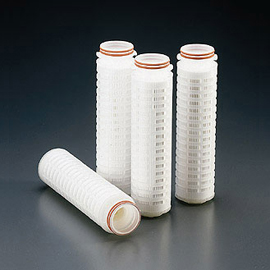
Plastic fibreglass filter cartridges: with a high quality polypropylene housing. Providing a large internal surface area, for depth filtration.
0.2 micron: for non-dry wines and ciders; this removes yeast and bacteria, £51.00 99.9% of the particles larger than the specified micron rating will be trapped on or within the filter. |

|
Stainless steel filter cartridges:- They provide only surface filtration, so require more frequent 'back-flushing' than the polypropylene cartridges do;
you can read the back-flushing procedure lower down on this page. Robust stainless steel 'basket' cartridges should last a very long time. or 10 micron £159.00, or 50 micron £174.00 |
5 micron will remove very small solid and semi-solid particles suspended in first pressing oil.
The oil can thus be visually clear while maintaining its original colour and properties and the opacity typical of high quality oil.
It is not possible for the human eye to see individual particles of less than 35 microns.
If there is a fine haze in the liquid being filtered, these cartridges will not remove it; it depends on the range of particle sizes in the liquid.
To achieve 'crystal clear' you probably need to use a finer standard cartridge, 1 micron or smaller.
You may need to fine the liquid rather than filter, depending on what the haze is caused by.
 Enolclean-Enolsan: powder for washing and sanitising filter cartridges; it is not suitable for oils.
Make up a 10 grams/litre solution, 250 grams is enough for 25 cleanings, £11.50
Instead of Enolsan you can use any mild sterilising solution (for example Milton, which is widely available, https://en.wikipedia.org/wiki/Milton_sterilizing_fluid)
or peracetic acid (2% solution, as used by many breweries). Then rinse throroughly with fresh water, as in the following procedure:-
First back-flush the cartridge with clean water while it is in the Tandem housing; just connect the hoses the
opposite way around and then follow the usual filling procedure until the water is clear.
Then remove the cartridge and soak it in the Enolsan solution, for between 1 and 12 hours, agitate it in the solution from time to time.
Warm water can be used (maximum 60°C) to make the Enolsan solution.
Then rinse thoroughly with clean water, and allow the filter to dry completely.
Then store it in a dry but airy place. Do not store the cartridges in a freezer.
The washing/sanitising process for stainless steel cartridges is the same.
Washing a polypropylene cartridge does not restore the white colour of a new cartridge, but it will remove most of the residues retained during processing.
Some colour from red wine remains visible.
On average, when filtering wine, a polypropylene cartridge has a duration of about 2500 litres of filtered product.